
Your workdays are filled with choices, from hiring and budgeting to clinical judgments and engineering trade-offs. Here is the catch: our brains lean on shortcuts that can quietly distort judgment. That is why understanding Cognitive biases, rational decision-making, psychology is not just academic—it is career-critical. When you can spot the cognitive traps and add the right decision guardrails, you reduce costly errors, move faster with clarity, and create outcomes you can back with data. Ready to upgrade the way you think under pressure?
Cognitive Biases, Rational Decision-Making, Psychology: The Essentials
Cognitive biases are predictable thinking patterns that deviate from objective logic and can skew how we interpret information, estimate probabilities, and choose actions. They arise from useful mental shortcuts called heuristics, which save time and energy but can misfire in complex, high-stakes contexts. Psychology shows that our brains use fast, automatic processes for quick judgments alongside slower, deliberate analysis for complex reasoning. This dual-process view, popularized in behavioural science, explains why brilliant professionals can still fall for framing effects or loss aversion in tense moments.
Think of your mind as having two gears: one that snaps to a conclusion and one that cross-checks. The snap-to gear excels when recognizing a face or sensing danger, but it struggles with base rates and compounding risk. The cross-checking gear can weigh alternatives, but it is lazy and tires easily under deadlines and noise. Ever wonder why the same numbers can lead two smart teams to opposite decisions? Subtle framing, like emphasizing gains versus losses, can swing choices even when the math is identical.
Importantly, biases are not moral failings; they are side effects of bounded rationality—your limited time, information, and attention. In environments with uncertainty, incomplete data, and social pressure, some shortcuts help, but others create blind spots. The professional edge is not to eliminate heuristics but to use them wisely and design processes that force verification. With a small toolkit—checklists, base rates, structured dissent—you can keep quick thinking while upgrading accuracy, speed, and fairness.
The Biases You Will Meet at Work
Across Human Resources (HR), finance, engineering, healthcare, and education, a handful of biases show up over and over. Research shared in outlets like Harvard Business Review (HBR) and decision analytics reports suggests that teams using structured methods outperform ad hoc choices in both quality and speed. Diverse teams also make better decisions at appreciably higher rates, especially when the process invites dissent and data. Where do the pitfalls usually start? Often with small cues—first impressions, a recent win or failure, or an anchor set by the opening number in a negotiation.
- Confirmation bias: Seeking evidence that supports your initial belief while discounting disconfirming data.
- Anchoring: Relying too heavily on first numbers or ideas, even when later information conflicts.
- Availability heuristic: Overweighting recent or vivid events, such as a headline or a memorable outage.
- Loss aversion: Feeling losses more strongly than equivalent gains, which can stall necessary change.
- Overconfidence effect: Overestimating your knowledge or the precision of your forecasts.
- Sunk cost fallacy: Continuing a project because of past investment rather than future value.
- Halo effect: Letting one positive trait inflate overall judgment, common in hiring and performance reviews.
- Groupthink: Suppressing dissent to preserve harmony, which blocks risk identification.
| Common Biases at a Glance | |||
| Bias | Everyday Cue | Team Risk | Quick Guardrail |
|---|---|---|---|
| Anchoring | “The first quote seems reasonable.” | Overpaying or underscoring | Generate 3 independent estimates before seeing a bid |
| Confirmation | “This supports what we thought.” | Blind spots in risk assessment | Assign a devil’s advocate to find disconfirming data |
| Availability | “We just had an outage, so it will happen again.” | Overreacting to recency | Check base rates from a year of incidents |
| Loss aversion | “We cannot risk losing current users.” | Delaying necessary pivots | Compare expected value of change vs. status quo |
| Sunk cost | “We already spent six months.” | Throwing good resources after bad | Use future value only in go or no-go decisions |
| Halo effect | “Great school, must be a star.” | Mis-hires or uneven reviews | Blind resume screens and structured scoring |
From Awareness to Action: A Practical Model for Better Choices
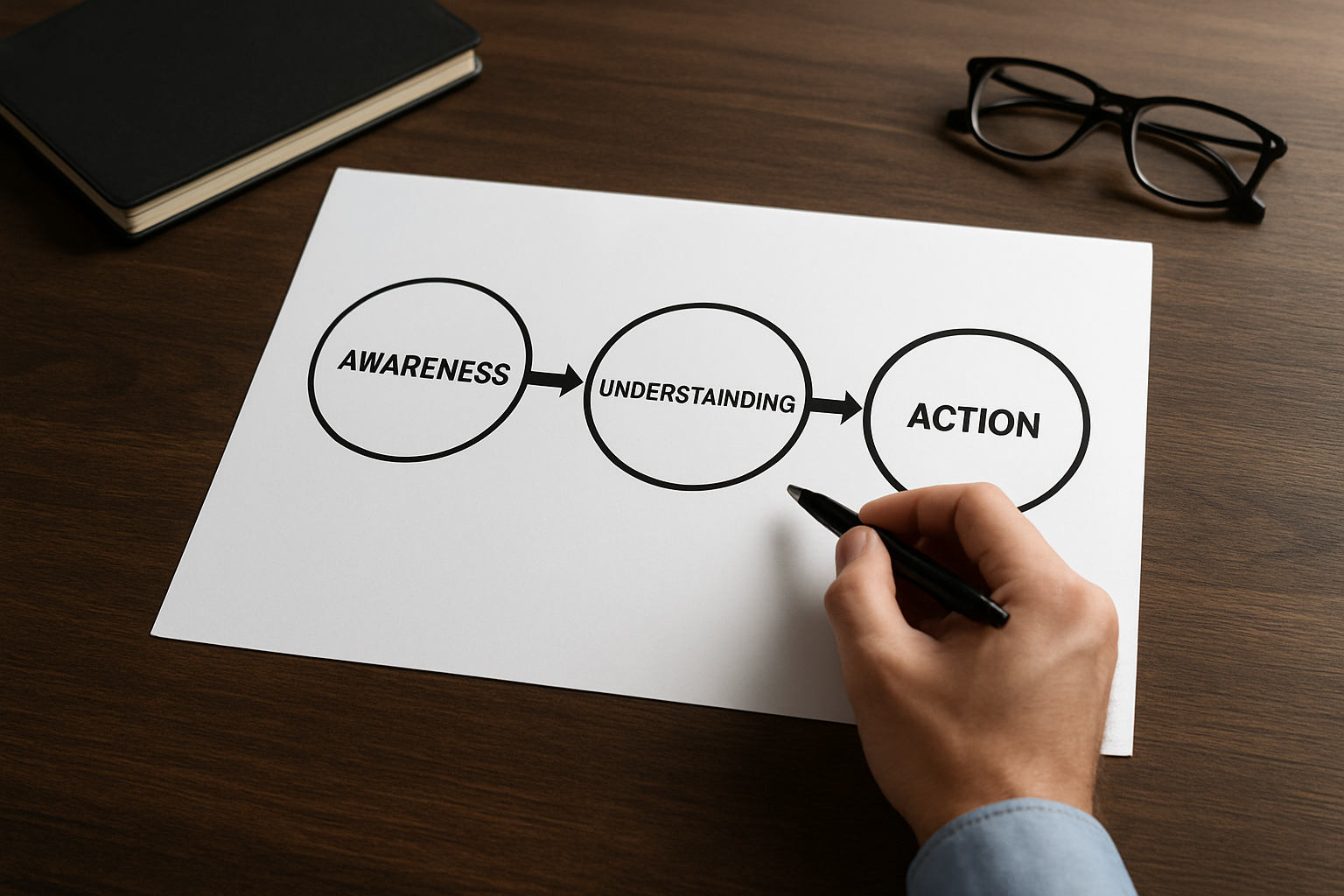
Knowing the names of biases is a start; building repeatable habits is what changes outcomes. Below is a pragmatic approach you can run in 15 to 60 minutes for most decisions and scale up for strategic choices. Use it for budget approvals, vendor selection, clinical protocols, engineering trade-offs, curriculum design, or policy changes. The goal is to transform gut reactions into disciplined judgment without adding unnecessary complexity.
- Define the decision: Write one sentence that states the choice, the time horizon, and the success metric.
- List alternatives: Ensure at least three viable options; options explode insight more than arguments do.
- Gather base rates: Pull historical performance, failure frequency, or external benchmarks for context.
- Pre-mortem: Ask, “It is six months later and we failed—what went wrong?” Capture 5 to 10 plausible causes.
- Score with criteria: Weight 3 to 5 criteria, including risk and reversibility, then rate options against them.
- Decide and document: Record the reasoning, assumptions, and a revert point when you would change course.
To make this sticky, consider the DECIDE (Define, Explore options, Compare with criteria, Investigate base rates, Decide, Evaluate) mnemonic. You will notice it deliberately slows down the parts where bias bites hardest: ignoring alternatives, neglecting statistics, and skipping dissent. Run it solo in a notebook or with a cross-functional group for higher-stakes calls. Over time, your team builds a library of decisions that speeds up future choices while reducing repeat mistakes.
- Bias busters checklist: Ask what could disconfirm your favourite option, what data would change your mind, and who disagrees and why.
- Decision hygiene: Separate analysis from advocacy; keep estimates independent until the reveal; and label assumptions explicitly.
- Reversibility test: If a choice is easy to reverse, bias-proof lightly and move; if it is hard to reverse, escalate scrutiny.
Evidence-Based Tools and Tactics
Some tools are especially good at neutralizing specific biases, and their impact is backed by research across healthcare, aviation, and finance. For example, the World Health Organization (WHO) surgical safety checklist was associated with roughly one-third fewer complications in early multi-country studies. Pre-mortems reliably surface hidden risks, and reference class forecasting improves project estimates by forcing attention to statistical outcomes rather than wishful thinking. Meanwhile, decision logs combat hindsight bias and speed onboarding by clarifying what was known, what was assumed, and what triggered the call.
Use tools that match decision type and timebox. For a vendor negotiation, independent estimates fight anchoring; for product bets, expected value and base rates cool loss aversion; for hiring, structured interviews minimize the halo effect and noise. Leaders can also assign a red team to challenge the prevailing view, especially when stakes are high and groupthink looms. Finally, agree on a handful of Key Performance Indicator (KPI) thresholds that would trigger a pivot—precommitting reduces escalation of commitment when emotions run hot.
| Bias-Reduction Toolset | |||
| Tool | Best Use | Bias Addressed | Time Cost |
|---|---|---|---|
| Independent estimates | Budgeting, vendor quotes, forecasts | Anchoring, groupthink | 5 to 15 minutes |
| Base rate check | Risk assessment, project plans | Availability heuristic, overconfidence | 10 to 30 minutes |
| Pre-mortem | Strategy, product, clinical protocols | Confirmation, optimism bias | 15 to 45 minutes |
| Structured interview | Hiring and performance reviews | Halo effect, noise | 30 to 60 minutes |
| Decision log | High-stakes or recurring choices | Hindsight bias, escalation of commitment | 5 minutes ongoing |
| Red team challenge | Strategic bets and safety-critical calls | Groupthink, confirmation | 30 to 90 minutes |
Case Studies: Rational Decision-Making in the Real World

Hiring with structure: An Human Resources (HR) team noticed inconsistent interview outcomes and rising rework in onboarding. By shifting to structured interviews with standardized rubrics, blinded resume review, and a devil’s advocate memo, the team reduced mis-hire rates across two quarters and improved new-hire performance consistency. Internal metrics showed fewer surprises during probation and higher satisfaction among interviewers who valued clarity over charisma. The process also made decisions more defensible when challenged.
Capital allocation with base rates: A finance group was considering extending a product that had loyal users but softening margins. The team ran a reference class forecast using external category data and internal cohorts, then computed expected value under multiple scenarios. Instead of escalating an investment due to sunk costs, they redirected funding to a higher-upside initiative with clear leading indicators. Follow-up reviews at 90 and 180 days helped them adjust quickly as new data came in.
Engineering risk with pre-mortems: An engineering organization preparing a platform migration used a pre-mortem to list potential failure modes that standard risk logs had missed. The exercise uncovered hidden dependencies and staffing gaps that could have caused cascading outages. With staged rollouts, extra on-call staffing, and a rollback protocol, the team reduced incident severity despite similar change volumes. Informal retrospectives highlighted the pre-mortem as the step that unlocked the most useful dissent.
| Case Study Highlights | |||
| Context | Main Bias | Intervention | Observed Benefit |
|---|---|---|---|
| Hiring | Halo effect | Structured interview plus blinded screening | More consistent performance and fewer mis-hires |
| Investment | Sunk cost and loss aversion | Reference class forecast and expected value | Capital shifted to higher-upside projects |
| Migration | Confirmation and availability | Pre-mortem and staged rollout | Lower incident severity and faster rollback |
Training Your Brain: Building Decision Fitness
Bias-proofing is a skill, and like any skill, it gets stronger with guided practice, feedback, and repetition. That is where Apex Virtual Education can help you and your organization build durable decision capability without pausing your day job. Apex Virtual Education provides a broad catalogue of online, skill-focused courses with certificates taught by industry experts, enabling learners to study anytime and anywhere. You can choose from curated categories— and track progress via your account after registration.
Apex Virtual Education’s unique advantage is breadth plus practicality: Business, Accounting or Finance (Accounting/Finance), Technology, Engineering, Health, Arts, Academics, Human Resources (HR), and Self-Improvement. Courses combine foundations and hands-on practice so you can apply ideas the same day. Many learners cite testimonials and course reviews for choosing the right level, and each completed course issues a certificate you can present to your manager or include on your profile.
How do you connect learning with real work? Start with your role, identify the most frequent decision you face, and pick a micro-course or series that sharpens that decision. A manager might pair behavioural decision-making with data visualization; a clinician might add risk communication and checklist design; an engineer might focus on estimation and reliability. Employers can also use the platform as a training resource for staff, assigning course lists tied to Key Performance Indicator (KPI) improvements like reduced rework or improved forecast accuracy.
| Course-to-Outcome Map with Apex Virtual Education | ||||
| Audience | Skill Gap | Relevant Category | What You Practice | Credential |
|---|---|---|---|---|
| People leaders | Hiring and performance decisions | Human Resources (HR), Business | Structured interviews, bias-aware reviews, decision logs | Certificate of completion |
| Finance professionals | Forecasting and capital bets | Accounting/Finance, Business | Base rates, expected value, scenario analysis | Certificate of completion |
| Engineers | Estimation and risk trade-offs | Engineering, Technology | Reference class forecasting, pre-mortems, reliability thinking | Certificate of completion |
| Healthcare practitioners | Checklists and safety culture | Health | Checklist design, risk communication, cognitive debiasing | Certificate of completion |
| Students and early-career | Learning how to learn | Academics, Self-Improvement | Study strategies, metacognition, feedback loops | Certificate of completion |
| Creative professionals | Framing and audience influence | Arts, Business | Framing effects, storytelling with data, ethical persuasion | Certificate of completion |
Want a mental picture to remember? Imagine a sketch with two halves: on the left, a lightning bolt for speed and intuition; on the right, a calculator for deliberate analysis. Your goal is not to switch off the lightning; it is to wire in the calculator at the right moments. Apex Virtual Education’s skill-based, foundational curriculum makes that wiring practical, stepwise, and directly tied to the outcomes you care about—better choices, shorter cycles, and stronger careers.
Metrics That Keep You Honest
What gets measured, improves. Define a small dashboard that captures decision quality and speed, so you can see whether your new habits pay off. Track items like option count per decision, percentage of decisions logged, days to decision, and pivot triggers honoured. Research summarized in management and operations journals suggests that even lightweight scorecards reduce bias drift over time by making the process visible and repeatable.
Set quarterly reviews where teams sample a few important decisions and test them against standards. Did we gather base rates? Did we consider reversibility? Did we explicitly document assumptions and a revert point? These debriefs are short but powerful, surfacing where biases are creeping in again and clarifying the one habit to strengthen next.
| Decision Quality Scorecard | |||
| Measure | Target | Why It Matters | Bias Countered |
|---|---|---|---|
| Options per decision | At least 3 | Forces broader search and reduces tunnel vision | Confirmation |
| Base rate check | 80 percent of major calls | Improves calibration and realism | Availability, overconfidence |
| Documented assumptions | All strategic decisions | Enables faster learning and clearer pivots | Hindsight bias |
| Red team or dissent | When impact is high | Catches hidden risks early | Groupthink |
| Reversibility labelled | Every choice | Right-sizes the rigor and speed | Escalation of commitment |
When you are ready to go deeper, Apex Virtual Education’s course library helps you turn these practices into muscle memory. Because the platform issues a certificate for each completed course, you can signal your growth to managers, clients, and peers. Industry expert instructors provide resource materials you can reuse in meetings and workshops, helping you scale decision hygiene beyond yourself.
Keep in mind that rationality is not perfection; it is a discipline of testing assumptions, running small experiments, and learning in public. The benefit is not just better results; it is calmer teams, clearer communication, and fewer regrets. Over time, you will find that the same meetings feel lighter and more productive because the process carries the weight, not the loudest voice. That is an advantage you can build starting today.
Key takeaways you can act on this week:
- Run a pre-mortem on your next important decision and address the top two risks immediately.
- Force three options and score them with a simple, weighted table.
- Log the decision, the assumptions, and the pivot trigger in a shared note.
- Schedule a 15-minute review after 30 days to examine outcomes and update your checklist.
As you build these routines, remember that your goal is not to become a different thinker, but to become a designer of better decisions. Small, consistent upgrades beat rare moments of brilliance. With courses from Apex Virtual Education and a few bias-busting practices, you can make high-quality choices your professional default.
Tip: If you facilitate meetings, assign roles like facilitator, scribe, and devil’s advocate ahead of time to balance participation and reduce groupthink. Rotate these roles so the process is fair and engaging. You will be surprised how quickly your team’s discussions shift from opinions to evidence, then from evidence to clear, accountable action.
Your next step is simple: choose one habit, one tool, and one course that will immediately raise the quality of your next decision. You are closer than you think.
Biases are predictable, but your process can be deliberately rational and repeatable.
Imagine the next 12 months with cleaner choices, lighter meetings, and a portfolio of decisions you would proudly audit. Build the habits now and let them compound.
As you step forward, what will you practice first from Cognitive biases, rational decision-making, psychology?
Additional Resources
Explore these authoritative resources to dive deeper into Cognitive biases, rational decision-making, psychology.
- Frames, Biases, and Rational Decision-Making in the Human Brain
- Rationality and Affective Biases. Do You Know What They Are?
Elevate Decisions with Apex Virtual Education
Strengthen decision-making and cognitive-bias awareness skills through a wide range of courses across Business, Accounting/Finance, Technology, Engineering, Health, Arts, Academics, Human Resources, Self-Improvement—learn anytime, earn certificates.