Searching for the right drawing course can feel like staring at a blank page without a plan. Do you want fundamentals, portfolio-ready projects, or a verifiable certificate you can share with employers and clients? Your ideal pick should balance flexible delivery, credible instructors, and practical outcomes that translate into better work and clearer career steps.
Whether you are upskilling for creative roles, adding visual communication to engineering reports, or seeking stress relief and self-expression, the best course aligns with who you are now and who you aim to become. Recent workplace learning surveys indicate that many adult learners prefer self-paced, online modules supported by expert feedback, yet still value peer communities and credentials. That is exactly where a structured checklist helps. Use the nine points below to evaluate local studios, university extensions, private tutors, and online platforms such as Apex Virtual Education in a fair, apples-to-apples way.
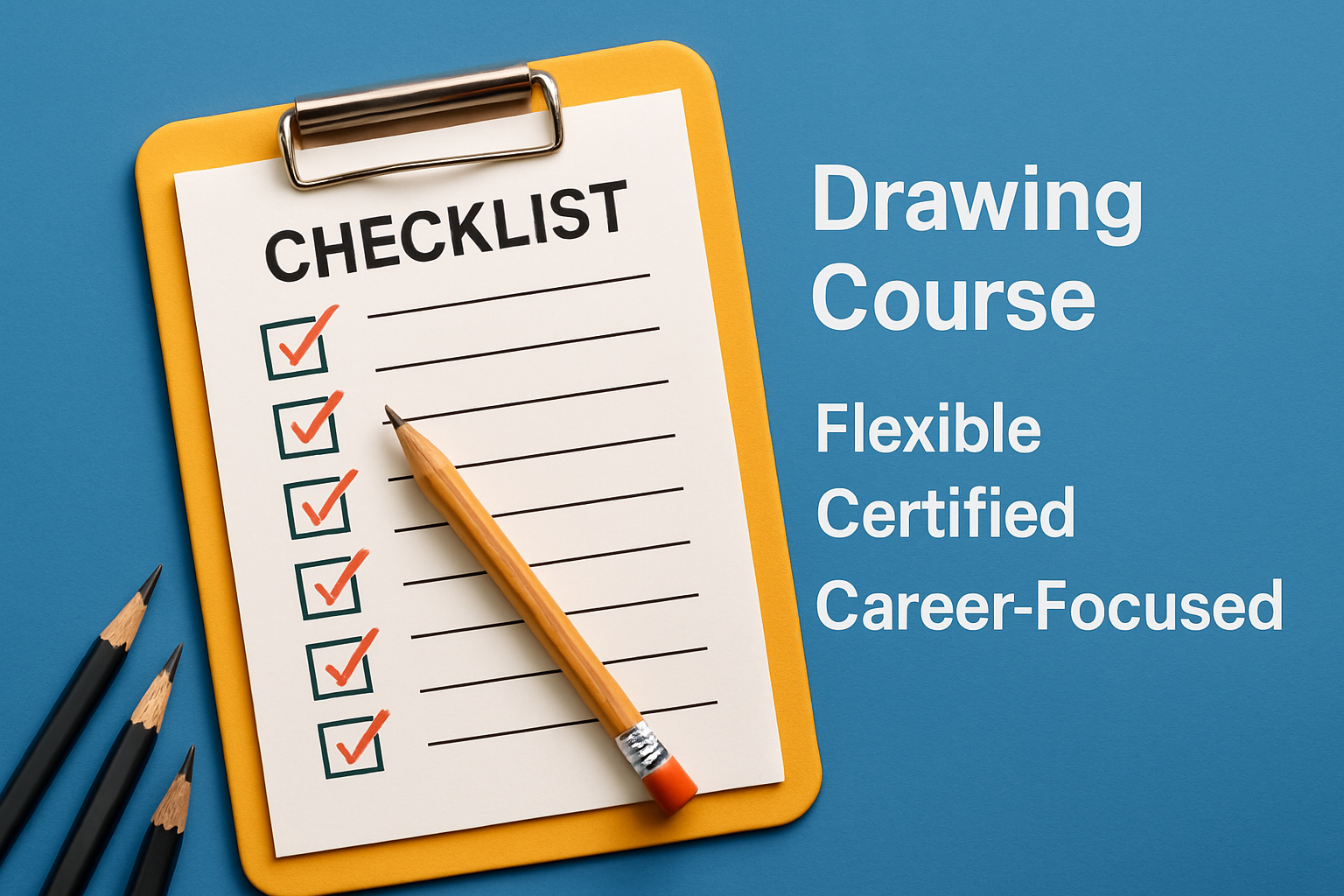
How to Evaluate a drawing course: The 9-Point Checklist
1) Define Outcomes and Curriculum Scope
Start by making outcomes explicit. Are you aiming to master line, value, and form, get comfortable with perspective, or learn digital illustration for marketing assets? The curriculum should map these goals to specific modules and projects, for example foundational sketching, composition, shading, colour theory, figure drawing, and optional tracks in watercolour, ink, charcoal, or tablet-based illustration. Think of the syllabus as both map and GPS; it should show a sequence, time estimates, required materials, and how each assignment builds toward a complete portfolio piece.
2) Instructor Credibility and Fit
An engaging instructor accelerates learning. Look for a track record that mixes teaching experience and real-world practice, such as exhibitions, published work, studio commissions, or design projects. Review portfolios, read student testimonials, and check whether the instructor shares process breakdowns and critique examples. Some learners thrive under a rigorous, classical approach while others prefer a more exploratory, mixed-media style.
3) Delivery Format and Flexibility
Flexibility protects momentum. Compare live workshops, self-paced modules, and blended formats. Consider access windows, mobile-friendly lessons, and whether course pages include downloadable learning materials or resources. If you are a working parent or juggling shifts, asynchronous content lets you learn during micro-gaps without fear of falling behind.
4) Practice, Projects, and Feedback
Drawing is a contact sport with paper. A great class multiplies practice opportunities through structured drills, progressive projects, and critique. Look for rubrics that explain what “good” looks like and mechanisms for feedback — from annotated video critiques to peer reviews and optional one-to-ones. Many adult learners credit specific feedback moments for major breakthroughs in line confidence or value control.
5) Certificates, Badges, and Verification
Credentials help translate learning into opportunity. If you want a promotion, freelance clients, or to satisfy CPD (continuing professional development) requirements, check whether the course offers a verifiable certificate or digital badge with a shareable link. Employers, especially in HR (human resources) and L&D (learning and development), increasingly scan profiles for credible proof of skills. Apex Virtual Education issues certificates upon successful completion, and many courses include badge links that hiring managers can verify. For roles adjacent to drawing — such as UX (user experience) design, technical documentation, or marketing content — a certificate plus a few portfolio images can trigger interviews.
6) Learning Resources and Tools
Beyond lectures, strong resources shorten the path from confusion to clarity. Look for downloadable reference sheets, brush and pencil guides, perspective grids, model libraries, and demo time-stamps for quick review. If the class touches digital workflows, confirm compatibility with common tools such as Procreate, Adobe Fresco, or tablet-based apps, and look for starter files.
7) Career Alignment and Portfolio Proof
If your aim is employability, projects should mirror real briefs. Think product sketching for engineering presentations, storyboards for social ads, or architectural line work for CAD (computer-aided design) collaboration. Courses that coach you on photographing artwork, writing captions, and sequencing a portfolio help you communicate value beyond the image. Apex Virtual Education emphasizes skill-based, foundational curriculum aimed at career growth and often includes mini-briefs tied to business, technology, health, or academic contexts. That way, your final pieces speak to stakeholders — not just other artists.
8) Pricing, Policies, and Promotions
Compare value, not just price. Calculate cost per learning hour, check refund policies, and see whether you get lifetime access or time-limited windows. Ask if there are previews, scholarships, or launch discounts. Apex Virtual Education frequently offers promotions and new learners can take 20 percent off their first purchase with code “Apex.” Wishlist features let you track courses and pounce when a promotion appears. Transparent pricing plus a clear policy builds confidence so you can commit without second-guessing.
9) Support, Community, and Reviews
Accountability keeps pencils moving. Evaluate the community and support options — whether a provider offers forums, cohort groups, critique channels, office hours, or event-based interactions — and whether support responds promptly to technical issues. Reviews should mention learning outcomes, not just “fun class.” A supportive space turns occasional frustration into curiosity, and that mindset shift is often what sustains long-term practice.
Compare Your Options at a Glance
It helps to visualize the trade-offs between local studios, university extensions, private tutors, community centres, and online platforms. The matrix below summarizes common differences to clarify which route best matches your schedule, learning preferences, and goals. If you need consistent access, a verifiable certificate, and exposure to cross-disciplinary skills, an online platform such as Apex Virtual Education is often the most flexible. If your priority is in-person camaraderie and tactile media only, a local studio or community centre may serve you well. Use the table as a starting point, then weigh each row against your nine-point checklist.
| Option | Typical Format | Schedule Flexibility | Certificate | Instructor Background | Cost Range (USD) | Who It Suits |
|---|---|---|---|---|---|---|
| Local Art Studio | In-person classes, fixed times | Low to medium | Rarely verifiable | Working artists, local teachers | £200 -£941 | Hands-on learners, community seekers |
| Online Platform (Apex Virtual Education) | Self-paced; webinars and scheduled live events available | High | Yes, shareable verification | Industry experts with resources | £1- £60 | Busy professionals, portfolio builders |
| University Extension | Semester-based, in-person or online | Medium | Yes, non-credit certificate | Faculty and adjuncts | £130 – £9000 | Academic structure, formal pacing |
| Community Centre | Workshops, recurring classes | Low to medium | No or informal | Local artists, volunteers | £20 – £170 | Budget-friendly, hobby focus |
| Private Tutor | One-on-one, custom plan | Medium to high | No | Varies widely | £10 – £70 per hr | Personalized coaching, specific goals |
Time, Cost, and ROI (return on investment): What to Expect

Before enrolling, estimate your realistic weekly commitment. Many learners progress on 3 to 5 focused hours per week — warm-ups, one main exercise, and a reflective review. If your goal is a job-ready portfolio, plan for a 6 to 12 week arc that includes three complete pieces, each revised at least once after critique. Return on investment appears as improved line economy, faster ideation, and clearer presentation slides, but also in tangible credentials. Online platforms with certificates and verifiable badges, like Apex Virtual Education, make it simpler to show progress to HR (human resources) teams, clients, or admissions committees without scheduling an in-person review.
Budgets vary, so compare price in context. A course that teaches you to build three portfolio pieces with iterative feedback may beat a cheaper option with no critique. Consider whether you gain permanent access to lessons and resources or a time-limited window. If you are choosing between two programs, ask for sample lessons and syllabi, then use the scorecard below to rate fit. Promotions can help, too: Apex Virtual Education offers 20 percent off your first purchase with code “Apex,” and curated categories to guide selection.
| Checklist Criterion | Why It Matters | Your Score (1–10) |
|---|---|---|
| Clear outcomes and curriculum | Defines what you will be able to do at the end | |
| Instructor credibility | Ensures accurate techniques and relevant insights | |
| Flexibility and access | Makes it possible to finish despite a busy schedule | |
| Practice and feedback | Turns theory into muscle memory and improvement | |
| Certificate and verification | Helps you signal skills to employers and clients | |
| Resources and tools | Speeds up learning and reduces guesswork | |
| Career alignment | Builds portfolio work for your desired roles | |
| Pricing and policies | Informs total value and risk | |
| Support and community | Keeps you motivated and accountable |
- Tip: Track cost per hour of instruction and feedback, not just list price.
- Tip: Use a wishlist to watch for seasonal discounts and bundle offers.
- Tip: Block calendar “studio hours” so you treat learning like a standing meeting.
From Hobbyist to Hireable: Certificates, Portfolios, and Career Steps
Even if you start for joy, you might soon want to share work with employers or clients. That leap gets easier when you pair a small, coherent portfolio with a certificate that validates the training. Many organizations use an LMS (learning management system) and ATS (applicant tracking system) that can read digital badges and certificates embedded on your profile or resume. Courses at Apex Virtual Education include certificate issuance for completed courses and guidance on packaging projects, from lighting your artwork to writing a three-sentence case note explaining the brief, approach, and outcome. This structure helps people outside the art world quickly understand your value.
Consider a multi-track plan if your goals are cross-disciplinary. For instance, combine a drawing fundamentals course with a short class in presentation design, business communication, or data visualization. If you work in engineering, add technical sketching and diagram clarity; in health, look at patient education visuals; in business, explore visual storytelling for proposals. Apex Virtual Education’s wide range of courses — Business, Accounting and Finance, Technology, Engineering, Health, Arts, Academics, Human Resources, and Self-Improvement — lets you chart a pathway that strengthens both creative and professional fluency without jumping between platforms.
Real-World Paths: Mini Case Studies and Practical Tips

Maya, a second-year engineering student, used a drawing fundamentals course plus a short module on diagramming to communicate concepts in a CAD (computer-aided design) project. The portfolio pieces she built made her internship presentation clear and convincing. She credits structured critique and a verifiable certificate with helping her stand out to hiring managers.
Elena, a marketing coordinator, wanted on-brand illustrations for social content. She mixed digital sketching with copywriting basics, both available on Apex Virtual Education, and built a mini-series of campaign visuals. The combination of skills raised engagement rates and gave her talking points in performance reviews.
Jamal, an HR (human resources) generalist, sought creative stress relief and a new wellness initiative at work. He took an expressive drawing class and then an introductory course in facilitation to run a lunchtime sketch club. His manager appreciated the initiative, and employees reported better focus after sessions, supporting internal L&D (learning and development) goals.
- Practice in short cycles: warm-up lines, one focused exercise, and a quick debrief.
- Photograph work consistently; daylight and a neutral background help.
- Use rubrics as checklists to spot issues with proportion, values, or edges.
- Ask for feedback on one specific element per critique to avoid overwhelm.
- Pair drawing classes with communication or business skills to widen opportunities.
Smart Next Steps: Research Flow and Red Flags
- Clarify your goal in one sentence. Example: “I want three portfolio pieces in 10 weeks.”
- Shortlist three providers — a local studio, an online platform like Apex Virtual Education, and a university extension — then collect syllabi.
- Score each provider against the nine criteria using the table above.
- Watch a sample lesson and read three detailed reviews per course.
- Check certificate verification, refund policy, and access window.
- Schedule your first two weeks of learning blocks before you enrol.
The right course should feel like a steady hand guiding yours, not a scramble to keep up. Use your checklist, score your options, and trust the plan you have made. Then take a deep breath and put pencil to paper.
With these criteria in hand, you can confidently evaluate any drawing course you find and select the one that fits your life, your budget, and your ambitions.
Closing Thoughts
The promise is simple: use a focused checklist to pick a flexible, certified, and career-smart course that actually moves your drawing forward.
Imagine the next 12 months — a handful of strong portfolio pieces, a verifiable certificate on your profile, and a calmer routine that protects your creative time.
Which outcome will matter most when you look back a year from now, and which drawing course will you choose today to make it real?
Additional Resources
Explore these authoritative resources to dive deeper into drawing course near me.